
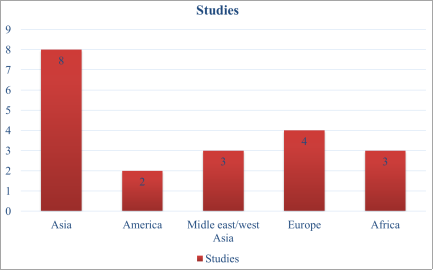
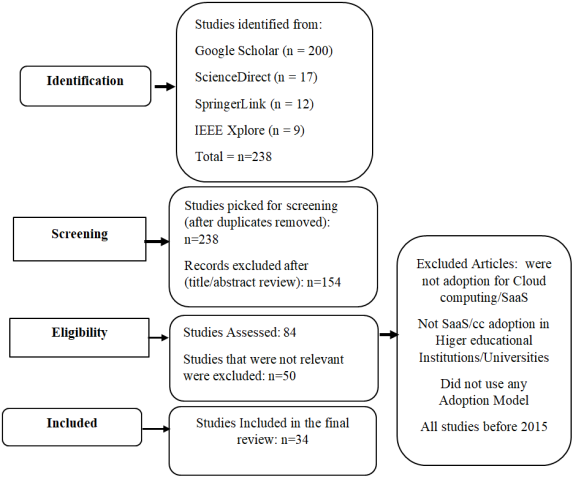
Since the early 2000s, Higher Education Institutions (HEIs) have increasingly adopted Software as a Service (SaaS). Despite benefits such as improved collaboration, efficiency, and reduced costs, adoption remains low in many developing regions, particularly Sub-Saharan Africa. Most research emphasizes organizational-level adoption, especially in East Africa, with limited focus on individual user factors. Using the PRISMA protocol, this review analyzed 34 studies from 2015–2025 sourced from Google Scholar, ScienceDirect, SpringerLink, and IEEE. The review examines factors influencing individual SaaS adoption in HEIs and evaluates three key models: TAM, UTAUT, and TRI, highlighting their strengths and limitations. Results show that UTAUT explains up to 70% of behavioral intention variance, compared to 40–60% for TAM. UTAUT expands TAM with additional constructs, while TRI is most effective when integrated with other frameworks. Key variables influencing user adoption were identified, offering insights to enhance individual uptake of cloud technologies in HEIs. Many studies apply TAM and UTAUT without contextual adaptation. Core constructs such as Perceived Usefulness (PU–39%), Perceived Ease of Use (PEU–94%), Facilitating Conditions (FC–50%), Social Influence (SI–44%), and Effort Expectancy (EE–50%) show higher significance than local/ External factors like skill transfer (6%), transition to e-learning (6%), and institutional policies (6%). Security and price emerge as the most prominent contextual factors that are addressed in roughly 39% and 17% of the studies respectively, this highlights their relative influence on technology adoption. Regionally, 80% of studies originate from Asia, reflecting strong academic interest and rapid digital growth. The Americas (20%) show less focus, possibly due to maturity in cloud adoption. Europe (40%) exhibits moderate engagement, while the Middle East/West Asia and Africa (30% each) show emerging research hindered by infrastructure, trust, and capacity challenges, leading to more emphasis on organizational adoption. The review identifies key variables shaping user adoption, offering insights to strengthen individual uptake of cloud technologies in HEIs across the region.
| Published in | American Journal of Computer Science and Technology (Volume 8, Issue 4) |
| DOI | 10.11648/j.ajcst.20250804.16 |
| Page(s) | 228-241 |
| Creative Commons |
This is an Open Access article, distributed under the terms of the Creative Commons Attribution 4.0 International License (http://creativecommons.org/licenses/by/4.0/), which permits unrestricted use, distribution and reproduction in any medium or format, provided the original work is properly cited. |
| Copyright |
Copyright © The Author(s), 2025. Published by Science Publishing Group |
Cloud Computing, Software as a Service, Higher Educational Institutions, Individual Level Adoption, Technology Acceptance Model, Technology Readiness Index, UTAUT
Database | Search String for each Database |
|---|---|
Google scholar | “SaaS/cloud computing Adoption” AND “Higher Educational Institutions” “SaaS/Cloud computing adoption using UTAUT” |
“SaaS/Cloud computing adoption using TAM” | |
Science Direct | [“SaaS/Cloud computing Adoption” AND “Higher Educational Institutions”] |
Stringer link | “Cloud Computing Adoption” AND “Higher Educational Institutions” |
IEEE | “Cloud Computing” “Adoption in Higher Educational Institutions” |
Assessment Questions | |
|---|---|
Q1 | Does the title of the paper clarify the idea of the research |
Q2 | Does the Abstract indicate the paper as a review/ Comparative analysis/Survey of SaaS adoption in Higher educational institutions |
Q3 | Does the Writer follow the systematic/Standard arrangement of the research paper? |
Q4 | Does the paper specify the SaaS adoption in HEIs? |
Q5 | Does the paper review multiple Adoption frameworks for SaaS? |
Q6 | Does the paper provide a review of Adoption frameworks? |
Item | Data Extracted |
|---|---|
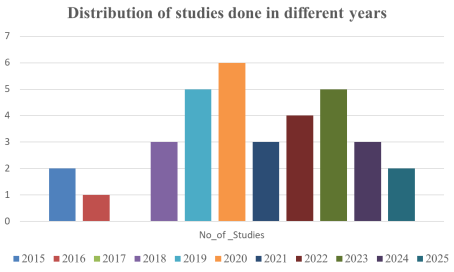
Years | Studies between 2015 to 2025 |
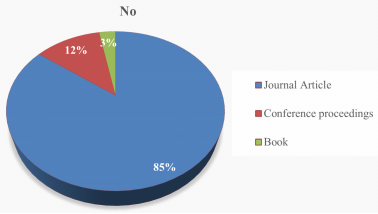
Type of Source | Journal, Conference Processing, books |
Region | Different Countries/Continents |
Variables | Variables were extracted in order to analyse how frequently they occurred. |
Reference / Study | Model/Level of adoption | Variables | Setting | Limitation |
|---|---|---|---|---|
[21] | UTAUT2- Researcher integrated 6 different Variables | E-trust, Skill transferability, social influence, facilitating conditions, Techno-Philia, Complexity, Perceived Risk, Technophobia, Behavioural Intention | Faculty members and Students in Bangladesh Public and Private universities | Does not breakdown vital facilitating conditions like internet connectivity (coverage and cost) |
[16] | TRI and TAM- Researcher integrates 4 different variables into the original TRI and TAM Models | Perceived Usefulness (PU) and Perceived Ease of Use (PE) (Optimism-Attitude) and Inventiveness-Organizational construct), (Discomfort - anxiety and uneasiness and Insecurity- | Individuals from Malaysian HEI | Limited external factors investigated. Does not take into consideration any Facilitating conditions |
[4] | TAM | PU, PEU-Information, cultural difference: compares turkey and Malysia | Students in Turkey and Malysia | Few variables to provide a wholistic view of adoption |
[16] | TAM | PU, PEU-Security and Learning Environment (shift from face to face) | Students, lecturers, and staff at HEI in Malaysia | Critical External factors are not included in the study |
UTAUT | EE, PE, SI, FC, Behavioural intention (BI), and Use behaviour (UB), | students from HEI schools in the district of Izmir, Turkey | Did no introduce any specific/External | |
[23] | UTAUT | EE, SI, Facilitating conditions, trust and attitude-No moderating variables | Undergraduates- Indian educational institutes. | Need to contextual by identifying more variables. |
[24] | UTAUT | BI and attitudes, Information management practices | Undergraduate students in HEI in Turkey | Limited variables. |
[20] | UTAUT | PE, EE, SI, FC, Moderator-Work type | Jordanian Universities | Proposes a study on more FC Like Supportive Policies, Motivations and Trainings |
[25] | UTAUT2 | PE, EE, SI, FC, Hedonic motivation, Price value, Habit, Behaviour intention | Vietnamese Universities | No demographic variables included in the study like age, gender and locations |
[26] | UTAUT | PE, EE, SI, FC | Ghana Universities | Specific to only Video Conferencing applications. SaaS applications, no modifications of framework. |
[27] | TAM 3 | PU, PEU, Subjective Norms, Image, Perceived enjoyment, Job Relevance, Output Quality and Result Demonstrability, Computer Playfulness, Computer Self Efficacy and Perceived External Control, Computer Anxiety, BI. | Turkey and UK | Examined a number of variables but with limited variables focusing on facilitating conditions |
[28] | TAM | PE, EE, SI, FC, Hedonic motivation, Habit, Content of platforms | India | Limited variables SaaS application was only tailored to MOOC |
[29] | TAM | Attitude, Ease of use, intention to use, SI, PE, Context of use, Infrastructure Perceived utility, of process, scalability, Availability of information, Price | Colombia | Well contextualized constructs but facilitating conditions are not elaborated. |
[30] | TAM | BI, PEU, Perceived usefulness, Reliability, Responsiveness | Oman | Very few external variables in cooperated into the framework |
[31] | TAM | PEU, PU, Perceived Security, Perceived ease of access, perceived cost of usage. | Thailand | Very few external variables in cooperated into the framework |
[32] | UTAUT | PE, Attitude towards using technology, EE, Anxiety, FC, BI, Self efficacy | South Africa | Facilitating conditions are not decomposed |
[33] | TAM | PU, PEOU, BI, External Variable: Security Concerns, Institutional Support, Financial support | Nigeria | Study done only on undergraduates leaving out important users like the instructors |
[34] | TAM | PE, EE, SI, FC, Trust in Technology, Attitude, Continued Intention | India | Limited decomposition of Facilitating conditions |
[35] | TAM | perceived usefulness and perceived ease of use | US | Limited External Variables |
Construct/Variable | No of studies | Frequency of Construct use |
|---|---|---|
PU | 7 | 39% |
PEU | 17 | 94% |
FC | 9 | 50% |
SI | 8 | 44% |
BI | 7 | 39% |
Attitude | 6 | 33% |
EE | 9 | 50% |
Security | 7 | 39% |
Institutional Policies | 1 | 6% |
Shift to E-learning | 1 | 6% |
Price | 3 | 17% |
Content | 1 | 6% |
Skill Transferability | 1 | 6% |
Study | Level/Enterprise | Model Used | Variables | Country |
|---|---|---|---|---|
[37] | Organizational Level Higher Educational Institutions | TOE | Cost saving, Relative advantage, Complexity, Security, Scalability, Time saving, dependent on external providers, technological readiness or existing culture, size of HEI, HE top Management, Cloud professional availability, SLA of providers, ministry of higher education support, pressure from competitor, promotion and marketing effort of providers, trainings, incentive availability in the environment | Somalia |
[38] | Organizational level-HEI | TOE | Technological, organizational and environmental factors | Kenya |
[39] | Organizational Level-HEI | TOE | Relative advantage, Complexity, compatibility, Competition, Pressure from partners, regulatory compliance Management support, Organization size, technology readiness | Malawi |
[40] | Organizational Level -HEI Libraries. | TOE | Staff skills, storage, Bandwidth, internet access, security and privacy, Funds for the project and intuitional policies | Kenya |
[41] | Higher education | Components of TOE | Top Management support Technical support User preparedness | Kenya |
[42] | Organizational Level Higher Educational Institutions | TOE With moderating Variables | Technological: Usability, Reliability, Security Organizational Readiness: ICT infrastructure, Cost Effectiveness, Top Management Organizational Environment: Institutional Pressure, Government Regulation, Vendor Support Moderating Variables: Quality of service, Trust, Experience | Kenya |
[43] | Organizational Level | TOE | Technological Factors, organizational Factors, Environmental, Social cultural factors | Ethiopia |
Variable | Occurrence from Reviewed papers | Description |
|---|---|---|
Perceived Usefulness (PU) | 39% | Very frequent. Almost every adoption that explores user adoption includes PU. |
Perceived Ease of Use (PEU) / Effort Expectancy (EE) | 94% 50% | Very common and it demonstrates Ease, simplicity, how much effort is required in using a technology. |
Facilitating Conditions (FC) | 50% | Frequently used, often as an organizational / environmental factor or external condition. |
Social Influence / Subjective Norms / Social Pressure (SI / SN) | 44% | Appears many times; especially in UTAUT / TAM. Explains how much friends/workmates can influence one to use a technology. |
Performance Expectancy (PE) | 39% | Commonly used in UTAUT Model |
behavioural Intention (BI) | 39% | It is a dependent or intermediary variable in many models. |
Attitude | 33% | in a few studies the variable is decomposed but for most studies it a general attitude toward adoption. |
Variable | Description |
|---|---|
Perceived Risk or Security | Very common variables in most studies. |
Price / Financial factors, Compatibility, Complexity | These are also predominant variables added by many researchers, these variables |
Lest frequently used variables across the studies | |
Technophobia, Techno philia | These variables are split from the attitude construct, very few studies decompose the construct |
E trust | Used in few studies. |
Skill Transferability | This variable is a decomposition from facilitating conditions and is further sub divide from variable training, according to the research, training may not be sufficient, the ability to transfer skills from training will facilitate adoption |
Cultural difference | Used in comparative studies like Turkey vs Malaysia. |
Information management | Some studies consider information management practices. |
Moderating variables like work type, (age, gender, experience, rural/urban etc.) | From the literature provided many studies omit or under use these, though UTAUT and others recommend them. |
Hedonic motivation, habit | Used mostly in the UTAUT 2 |
Content of platforms | Specific SaaS applications like You Tube, MOOC and others |
Discomfort, anxiety, uneasiness, insecurity | These are under the broader construct of Attitude and part of TRI Framework constructs |
Environment (shift from face to face) | Only a single study has explored this variable, despite the fact that numerous institutions worldwide and in Uganda have undergone a significant shift toward blended learning. |
SaaS | Software as a Service |
PaaS | Platform as a Service |
IaaS | Infrastructure as a Service |
UTAUT | Unified Theory of Acceptance and Use of Technology |
UTAUT2 | Unified Theory of Acceptance and Use of Technology 2 |
TAM | Technology Acceptance Model |
TRI | Technology Readiness Index |
TOE | Technology Organization Environment |
MOOC | Massive Open Online Course |
PRISMA | Preferred Reporting Items for Systematic Reviews and Meta-Analyses |
PE | Performance Expectancy |
EE | Effort Expectancy |
SI | Social Influence |
FC | Facilitating Conditions |
PU | Perceived Usefulness |
PEOU | Perceived Ease of Use |
BI | Behavioral Intention |
ICTs | Information and Communication Technologies |
E-Trust | Electronic Trust |
UB | User Behavior |
HEI | Higher Educational Institutions |
| [1] | G. S. David, "An Architecture for Cloud Computing in Higher Education," in 2015 International Conference on Soft-Computing and Network Security, India, 2015. |
| [2] | S. A. Mokhtar, "Identifying the Determinants of Cloud Computing Adoption in Higher Education Institutions," in 2016 International Conference on Information and Communication Technology (ICICTM), Malaysia, 2016. |
| [3] | R. M. Musudur, "A Model of Factors Influencing Cloud Computing Adoption Among Faculty Members and Students of Higher Educational Institutions of Bangladesh," in 2018 IEEE 5th International Conference on Engineering Technologies & Applied Science, Bangkok Thailand, 2018. |
| [4] | I. Arpaci, "Evaluating the actual use of cloud computing in higher education through information management factors: a cross-cultural comparison," Education and Information Technologies, pp. 1-21, 2023. |
| [5] | M. A. Al-Sharaf, "Cloud Computing Adoption in Higher Education: An Integrated Theoretical," 2022. |
| [6] | C. Kipkoech, "A model for adoption of Open Source Cloud Computing: Plat form as a service and Software as a service," International Journal of Computer Application Technology & Research, pp. 1-9, 2024. |
| [7] | P. K. Maina, "Preparedness towards adoption of cloud computing technologies by academic libraries in kenya," International Journal of Research in Library Science (IJRLS), vol. Volume 6, no. Issue 1 (Jan-June) 2020, 200-209, Paper ID: IJRLS-1320, pp. 1-10, 2020. |
| [8] | C. Too, "CRITICAL SUCCESS FACTORS FOR ADOPTION OF CLOUD COMPUTING IN PUBLIC UNIVERSITIES IN KENYA," European Journal, vol. Volume 8 │ Issue 10 │ 2021, pp. 1-15, 2021. |
| [9] | R. R. Thavi, "To determine the critical factors for the adoption of cloud computing in the educational sector in developing countries – a fuzzy DEMATEL approach," pp. 1-26, 2021. |
| [10] | N. M. Al-Ramahi, "The TOEQCC Framework for Sustainable Adoption of Cloud Computing at Higher Education Institutions in the Kingdom of Jordan," MDPI, pp. 1-19, 2022. |
| [11] | M. L. Rethlefsen, "PRISMA-S: an extension to the PRISMA Statement for Reporting Literature Searches in Systematic Reviews," 2021. |
| [12] | R. Sarkis-Onofre, "How to properly use the PRISMA Statement," 2021. |
| [13] | R. S. Onofre, "How to properly use the PRISMA Statement," Open Access, pp. 1-3, 2021. |
| [14] | A. E. Nyoko, "A Systematic Literature Review on Entrepreneurial Intention: PRISMA method," in Proceedings of the International Conference on Economic Management, Accounting and tourism, 2024. |
| [15] | S. D. Mwapwele, "Teachers’ ICT Adoption in South African Rural Schools: A Study of Technology Readiness and Implications for the South Africa Connect Broadband Policy," AJIC, pp. 1-21, 2019. |
| [16] | M. T. Amron, "Predicting the Acceptance of Cloud Computing in Higher Education Institutions by Extending the Technology Readiness theory," Asian Journal of University Education (AJUE), pp. 1-13, 2022. |
| [17] | A. T. Lee, " Understanding Psychosocial Barriers to Healthcare Technology Adoption: A Review of TAMTechnology Acceptance Model and Unified Theory of Acceptance and Use of Technology and UTAUTFrameworks," MDPI, pp. 1-35, 2025. |
| [18] | M. T. Amron, "Predicting the Acceptance of Cloud Computing in Higher Education Institutions by Extending the Technology Readiness Theory," Malaysia, 2022. |
| [19] | A. SANTOS, "Factors Affecting Cloud Computing Adoption in the Education Context—Systematic Literature Review," IEEE ACESS, vol. VOLUME 12, pp. 1-34, 2024. |
| [20] | N. Matar, "A Multi-Group Structural Equation Modeling For Assessing Behavioral Intention of Using Mobile Cloud Computing-The Case of Jordanian Universities During The Covid19 Pandemic," The International Arab Journal of Information Technology, pp. 1-11, 2022. |
| [21] | M. M. Rahman, " A Model of Factors Influencing Cloud Computing Adoption Among Faculty Members and Students of Higher Educational Institutions of Bangladesh," in 2018 IEEE 5th International Conference on Engineering Technologies & Applied Sciences,, Bangkok Thailand, 2018. |
| [22] | C. Saygıner, "Acceptance and Use of Cloud-Based Virtual Platforms by Higher Education Vocational School Students: Application of the UTAUT Model with a PLS-SEM Approach," International Journal of Technology and Educational Innovation, pp. 1-15, 2023. |
| [23] | G. Kabra, " Factors influencing adoption of cloud computing services in HEIs: a UTAUT approach based on students' perception," International Journal of Business Information Systems, pp. 1-21, 2019. |
| [24] | I. Arpaci, "A hybrid modeling approach for predicting the educational use of mobile cloud computing services in higher education," Computers in Human Behavior, pp. 1-7, 2019. |
| [25] | N. D. Thanh, "Factors affecting e-learning based cloud computing acceptance: an empirical study at Vietnamese universities," Journal of International Economics and Management, pp. 1-16, 2020. |
| [26] | J. K. E. Edumadze, "Undergraduate student's perception of using video conferencing tools under lockdown amidst COVID-19 pandemic in Ghana," Interactive Learning Environments, pp. 1-13, 2023. |
| [27] | N. B. HAMUTOGLU, "Acceptance and Use of Cloud Computing Systems in Higher Education: An Application of TAM 3 within the Socio cultural context of Educational Institutions," Malaysian Online Journal of Educational Technology, pp. 1-22, 2020. |
| [28] | M. M. Mohan, " Intention and barriers to use MOOCs: An investigation among the post graduate students in India," Education and Information Technologies, pp. 1-15, 2020. |
| [29] | D. Rico-Bautista, "Smart University: Key Factors for a Cloud Computing Adoption Model," Springer Nature Singapore, pp. 1-9, 2022. |
| [30] | S. Al-Hajr, "The cloud computing systems’ adoption in the higher education sector in Oman in light of the COVID-19 pandemic," International Journal of Evaluation and Research in Education (IJERE), pp. 1-8, 2021. |
| [31] | C. Changchit, "Cloud Computing: An Examination of Factors Impacting Users’ Adoption," JOURNAL OF COMPUTER INFORMATION SYSTEMS, pp. 1-10, 2018. |
| [32] | J. Liebenberg, "Acceptance of ICT: Applicability of the Unified Theory of Acceptance and Use of Technology (UTAUT) to South African Students," The African Journal of Information Systems, pp. 1-15, 2018. |
| [33] | OMOTUNDE, "INVESTIGATING FACTORS THAT INFLUENCE THE ADOPTION OF CLOUD COMPUTING TECHNOLOGIES AMONG UNDERGRADUATES IN NIGERIAN UNIVERSITIES," Journal of Science Vocational and Technical Education (JOSVTE)., pp. 1-15, 2024. |
| [34] | K. Gaurav, "Factors influencing adoption of cloud computing services in HEIs: a UTAUT approach based on students' perception," International Journal of Business Information Systems, pp. 1-21, 2023. |
| [35] | H. Nafiu, "Perceptions of Cloud-Based Learning Facilities among U.S. College Students," INTERNATIONAL JOURNAL OF RESEARCH AND INNOVATION IN SOCIAL SCIENCE (IJRISS), pp. 1-18, 2025. |
| [36] | A. Aytekin, "Unified theory of acceptance and use of technology (UTAUT) in mobile learning adoption: Systematic literature review and bibliometric analysis," COLLNET Journal of Scientometrics and Information Management, Vols. Vol. 16(1) June 2022, pp. 75–116, pp. 1-43, 2022. |
| [37] | M. A. Isak, "IDENTIFYING THE FACTORS OF CLOUD COMPUTING ADOPTION IN HIGHER EDUCATION INSTITUTIONS – A CASE STUDY OF SOMALI HIGHER EDUCATION INSTITUTIONS," Research Gate, 2019. |
| [38] | E. M. Micheni, "Using the Technology Organization Environment Framework for Adoption and Implementation of Cloud Computing in Institutions of Higher Learning in Kenya," The International Journal Of Engineering And Science (IJES), 2015. |
| [39] | F. Makoza, "Cloud computing adoption in Higher Education Institutions of Malawi: An exploratory study," Research gate, 2020. |
| [40] | P. K. Maina, "Preparedness towards adoption of cloud computing technologies by academic libraries in kenya," International Journal of Research in Library Science (IJRLS), 2020. |
| [41] | C. Tooi, "CRITICAL SUCCESS FACTORS FOR ADOPTION OF CLOUD COMPUTING IN PUBLIC UNIVERSITIES IN KENYA," European Journal of Education Studies, 2020. |
| [42] | C. P. Kipkoech, "A Model for Adoption of Open-Source Cloud Computing: Platform as a Service and Software as a Service," International Journal of Computer Applications Technology and Research, pp. 1-9, 2024. |
| [43] | K. K. Hiran, "Anintegrated TOE–DoI framework for cloud computing adoption in the higher education sector: case study of Sub-Saharan Africa, Ethiopia," Int J Syst Assur Eng Manag, pp. 1-9, 2019. |
| [44] | S. Zaineldeen, "Technology Acceptance Model' Concepts, Contribution, Limitation, and Adoption in Education Samar Zaineldeen," Universal Journal of Educational Research 8(11): 5061-5071, pp. 1-11, 2020. |
APA Style
Ikwap, F. A., Oonge, S., Otieno, C. (2025). Systematic Review of Models Examining Factors Influencing SaaS Adoption in Higher Education Institutions. American Journal of Computer Science and Technology, 8(4), 228-241. https://doi.org/10.11648/j.ajcst.20250804.16
ACS Style
Ikwap, F. A.; Oonge, S.; Otieno, C. Systematic Review of Models Examining Factors Influencing SaaS Adoption in Higher Education Institutions. Am. J. Comput. Sci. Technol. 2025, 8(4), 228-241. doi: 10.11648/j.ajcst.20250804.16
AMA Style
Ikwap FA, Oonge S, Otieno C. Systematic Review of Models Examining Factors Influencing SaaS Adoption in Higher Education Institutions. Am J Comput Sci Technol. 2025;8(4):228-241. doi: 10.11648/j.ajcst.20250804.16
@article{10.11648/j.ajcst.20250804.16,
  author = {Flavia Agatha Ikwap and Samuel Oonge and Calvins Otieno},
  title = {Systematic Review of Models Examining Factors Influencing SaaS Adoption in Higher Education Institutions},
  journal = {American Journal of Computer Science and Technology},
  volume = {8},
  number = {4},
  pages = {228-241},
  doi = {10.11648/j.ajcst.20250804.16},
  url = {https://doi.org/10.11648/j.ajcst.20250804.16},
  eprint = {https://article.sciencepublishinggroup.com/pdf/10.11648.j.ajcst.20250804.16},
  abstract = {Since the early 2000s, Higher Education Institutions (HEIs) have increasingly adopted Software as a Service (SaaS). Despite benefits such as improved collaboration, efficiency, and reduced costs, adoption remains low in many developing regions, particularly Sub-Saharan Africa. Most research emphasizes organizational-level adoption, especially in East Africa, with limited focus on individual user factors. Using the PRISMA protocol, this review analyzed 34 studies from 2015–2025 sourced from Google Scholar, ScienceDirect, SpringerLink, and IEEE. The review examines factors influencing individual SaaS adoption in HEIs and evaluates three key models: TAM, UTAUT, and TRI, highlighting their strengths and limitations. Results show that UTAUT explains up to 70% of behavioral intention variance, compared to 40–60% for TAM. UTAUT expands TAM with additional constructs, while TRI is most effective when integrated with other frameworks. Key variables influencing user adoption were identified, offering insights to enhance individual uptake of cloud technologies in HEIs. Many studies apply TAM and UTAUT without contextual adaptation. Core constructs such as Perceived Usefulness (PU–39%), Perceived Ease of Use (PEU–94%), Facilitating Conditions (FC–50%), Social Influence (SI–44%), and Effort Expectancy (EE–50%) show higher significance than local/ External factors like skill transfer (6%), transition to e-learning (6%), and institutional policies (6%). Security and price emerge as the most prominent contextual factors that are addressed in roughly 39% and 17% of the studies respectively, this highlights their relative influence on technology adoption. Regionally, 80% of studies originate from Asia, reflecting strong academic interest and rapid digital growth. The Americas (20%) show less focus, possibly due to maturity in cloud adoption. Europe (40%) exhibits moderate engagement, while the Middle East/West Asia and Africa (30% each) show emerging research hindered by infrastructure, trust, and capacity challenges, leading to more emphasis on organizational adoption. The review identifies key variables shaping user adoption, offering insights to strengthen individual uptake of cloud technologies in HEIs across the region.},
 year = {2025}
}
TY  - JOUR
T1  - Systematic Review of Models Examining Factors Influencing SaaS Adoption in Higher Education Institutions
AU  - Flavia Agatha Ikwap
AU  - Samuel Oonge
AU  - Calvins Otieno
Y1  - 2025/12/19
PY  - 2025
N1  - https://doi.org/10.11648/j.ajcst.20250804.16
DO  - 10.11648/j.ajcst.20250804.16
T2  - American Journal of Computer Science and Technology
JF  - American Journal of Computer Science and Technology
JO  - American Journal of Computer Science and Technology
SP  - 228
EP  - 241
PB  - Science Publishing Group
SN  - 2640-012X
UR  - https://doi.org/10.11648/j.ajcst.20250804.16
AB  - Since the early 2000s, Higher Education Institutions (HEIs) have increasingly adopted Software as a Service (SaaS). Despite benefits such as improved collaboration, efficiency, and reduced costs, adoption remains low in many developing regions, particularly Sub-Saharan Africa. Most research emphasizes organizational-level adoption, especially in East Africa, with limited focus on individual user factors. Using the PRISMA protocol, this review analyzed 34 studies from 2015–2025 sourced from Google Scholar, ScienceDirect, SpringerLink, and IEEE. The review examines factors influencing individual SaaS adoption in HEIs and evaluates three key models: TAM, UTAUT, and TRI, highlighting their strengths and limitations. Results show that UTAUT explains up to 70% of behavioral intention variance, compared to 40–60% for TAM. UTAUT expands TAM with additional constructs, while TRI is most effective when integrated with other frameworks. Key variables influencing user adoption were identified, offering insights to enhance individual uptake of cloud technologies in HEIs. Many studies apply TAM and UTAUT without contextual adaptation. Core constructs such as Perceived Usefulness (PU–39%), Perceived Ease of Use (PEU–94%), Facilitating Conditions (FC–50%), Social Influence (SI–44%), and Effort Expectancy (EE–50%) show higher significance than local/ External factors like skill transfer (6%), transition to e-learning (6%), and institutional policies (6%). Security and price emerge as the most prominent contextual factors that are addressed in roughly 39% and 17% of the studies respectively, this highlights their relative influence on technology adoption. Regionally, 80% of studies originate from Asia, reflecting strong academic interest and rapid digital growth. The Americas (20%) show less focus, possibly due to maturity in cloud adoption. Europe (40%) exhibits moderate engagement, while the Middle East/West Asia and Africa (30% each) show emerging research hindered by infrastructure, trust, and capacity challenges, leading to more emphasis on organizational adoption. The review identifies key variables shaping user adoption, offering insights to strengthen individual uptake of cloud technologies in HEIs across the region.
VL  - 8
IS  - 4
ER  -
Department of Information Technology, Maseno University, Kisumu, Kenya
Department of Information Technology, Maseno University, Kisumu, Kenya
Department of Information Technology, Maseno University, Kisumu, Kenya




 Share This Article
 Twitter
 Linked In
 Facebook
 Copy
Copy Download